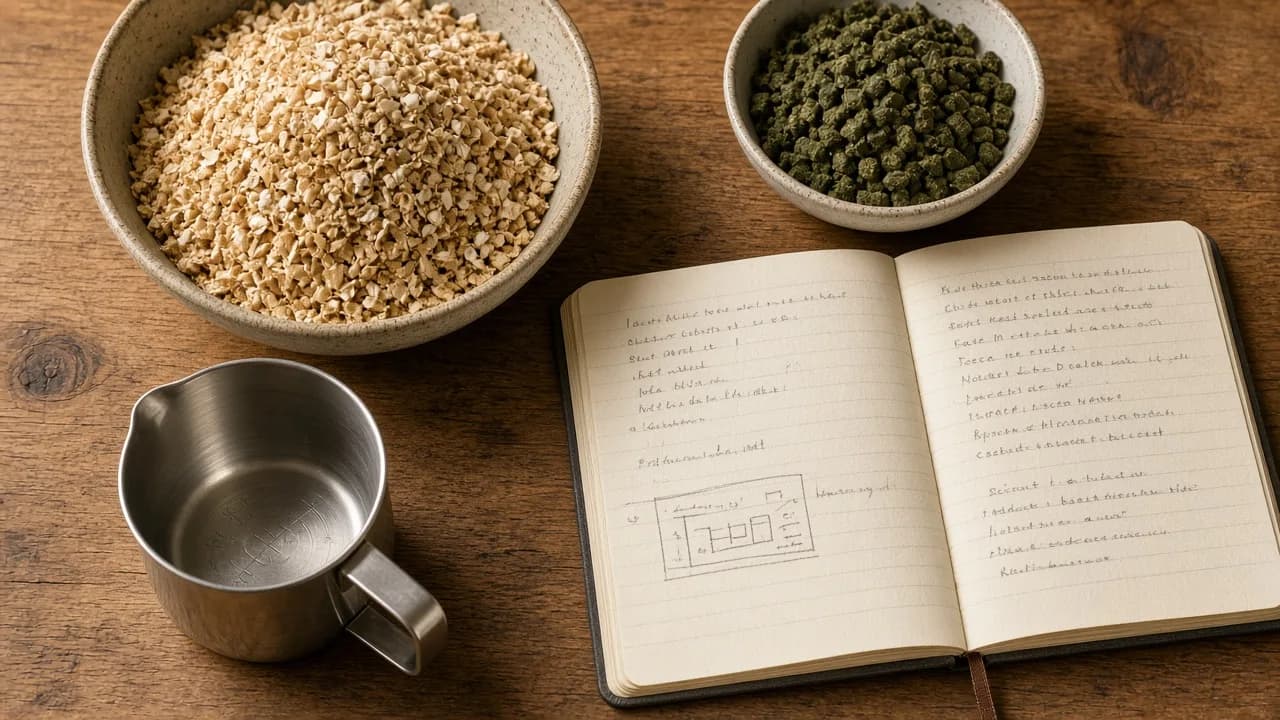
All-grain brewing is a process, not a product pack. You crush malt, mix it with water at a temperature that lets enzymes convert starch to fermentable sugar, hold that mash until conversion is good enough, separate the sweet wort, then boil with hops as you would an extract beer.
The heritage path once sat next to “recipe packs.” Those SKUs 301 to recipes. This page keeps the method.
Mash
Heat strike water so that, after you add grain, the mash sits in the conversion band your recipe named — often around the mid-60s Celsius for a moderately fermentable ale, slightly lower for a drier beer, slightly higher for a fuller one. Use a thermometer. Dough in without dry balls of malt. Hold the temperature. Stir as needed.
Iodine tests and time both get used as conversion checks. A mash that is wildly out of temperature will not magically become wort because you waited an extra twenty minutes.
Brew-in-a-bag (BIAB) and three-vessel systems are both mashes. BIAB lifts the grain. A cooler tun drains wort through a manifold. Choose for the equipment you can lift when it is wet.
Lauter and sparge
You want sweet wort in the kettle and spent grain in the compost, not a stuck mess. Rice hulls help sticky wheat or oat mashes. Sparge water should not be so hot that you extract astringency. Runoff should not be so violent that you compact the grain bed.
Collect the volume you intended to boil, remembering that you will lose liquid to evaporation and to grain absorption.
Boil
Boil long enough for your hop schedule and for the hot-break hygiene a rolling boil provides. Add hops at the times the recipe named. Watch for boil-overs — Australian kettles on a domestic stove do this cheerfully.
Cool before you pitch. The rest is the beginners ferment.
What this page will not do
It will not publish a “Lashes clone” or any other trademarked commercial beer as a sales recipe. Archive clone URLs 301 to recipes. Write a BJCP-family specification instead.
It will not invent efficiency percentages for your bag. Measure original gravity and adjust the next grist.
All-grain beer is still alcohol. The NHMRC 2020 guidelines apply when the keg kicks.
If you are not ready to mash, extract brewing is not a lesser path. It is how you practise sanitation and gravity without also practising strike-temperature arithmetic.
pH, briefly
Mash pH sits in a band that helps enzymes and wort flavour. If you chase it, use a meter you trust and small acid adjustments. If you do not chase it yet, use a simple pale-ale grist and good water, then learn pH on batch five rather than batch one. This page will not invent a target to six decimal places.
Stuck mashes
Wheat, rye and oats stick. Rice hulls, a gentler runoff, and a slightly coarser crush help. A stuck mash is annoying. It is not a reason to tear the bag and flood the kitchen. Wait, recirculate gently, and add hulls next time.
Record keeping
Write strike volume, strike temperature, mash temperature, mash time, pre-boil gravity, boil length, original gravity. Those six lines turn a lucky beer into a recipe you can brew again.
Archive “23lt BIAB” URLs 301 to recipes because they were packs. Your notebook is the pack now.
Safety
Wet grain is heavy. Hot wort is heavier. Lift with a plan or do not lift. Keep children away from the kettle. All-grain day is longer than kit day; eat something so you do not rush the chill.
The beer you mash is still alcohol at the end. The NHMRC 2020 guidelines apply when you finally pour it.